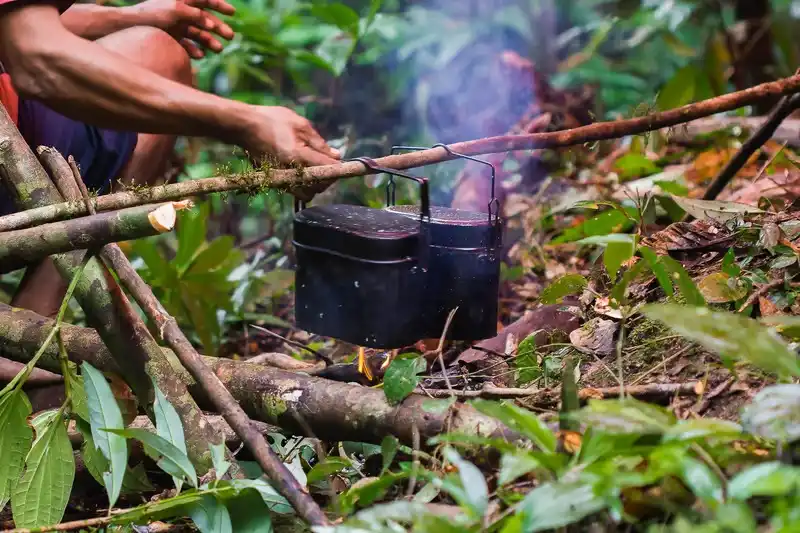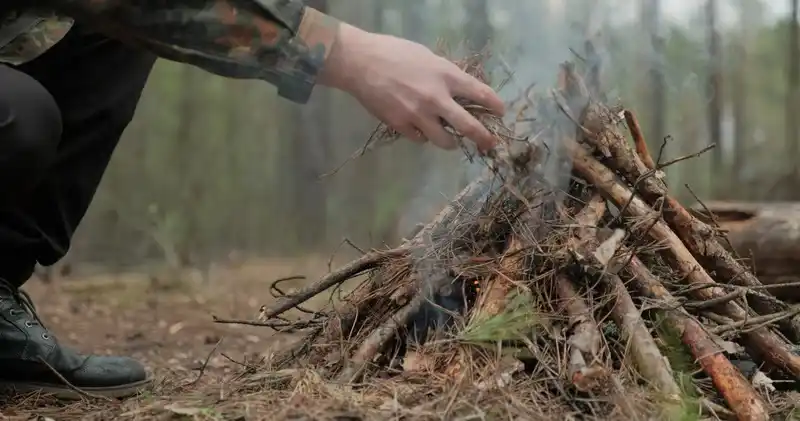
There is something humbling about holding a trap you built entirely from what the forest gave you. No hardware store materials, no manufactured components, no instructions printed on a box. Just cordage twisted from plant fibers, a trigger notched from a green branch, and the accumulated knowledge of thousands of years of human survival compressed into a mechanism small enough to hold in one hand. Primitive trapping techniques are among the oldest practical skills in human history. Long before agriculture, before animal husbandry, before any of the food systems we take entirely for granted today, human beings fed themselves and their families by reading animal sign, understanding behavioral patterns, and constructing ingenious mechanical devices that worked while the trapper slept, hunted elsewhere, or gathered other food. This passive food procurement strategy was not simply clever. It was essential. A single person cannot chase enough game to sustain themselves through a wilderness winter. But that same person, with the knowledge to set twenty well-placed traps along active game trails, can generate a steady and reliable protein supply that makes survival genuinely possible. Today, primitive trapping techniques occupy a unique space in the outdoor skills community, valued simultaneously as historical knowledge, genuine survival competency, and a profound connection to the human experience that preceded every modern convenience. This guide explores the most important of these techniques with the depth and respect they deserve.
Why Primitive Trapping Skills Remain Critically Relevant Today
Before examining specific techniques, it is worth addressing the question that some people raise about why primitive trapping matters in a world where survival kits include modern snares, hunting licenses govern game harvest, and emergency rescue is often hours away rather than weeks. The answer operates on several levels simultaneously. At the most practical level, primitive trapping techniques are relevant because survival situations are defined precisely by the absence of the modern tools and systems we normally rely upon. A hiker who becomes lost for three days in remote wilderness with only the contents of their daypack does not have modern trapping equipment. A person who survives a vehicle breakdown in a remote area in winter does not have the luxury of waiting for a resupply. In these situations, the ability to construct functional traps from available natural materials is not a romantic attachment to the past. It is a genuine, practical survival competency that can provide critical protein when the body needs it most. Beyond the immediate survival context, primitive trapping techniques represent a category of knowledge that deepens every other wilderness skill. Understanding animal behavior well enough to trap effectively makes you a better tracker, a better hunter, a better naturalist, and a more capable wilderness traveler in every sense. The patience, observation, and environmental reading that successful primitive trapping requires are transferable skills that improve your overall competence in natural environments in ways that no amount of gear can replicate.
The Ethical and Legal Framework Surrounding Primitive Trapping
Any serious discussion of primitive trapping techniques must include an honest treatment of the ethical and legal context in which they exist. In most jurisdictions in North America, Europe, and Australia, trapping without a valid license is illegal regardless of the type of trap used, and this includes primitive traps constructed from natural materials. The legal exceptions that apply in genuine survival emergencies are narrow, jurisdiction-specific, and require that the emergency be real and documented rather than presumed. This legal reality means that practicing primitive trapping techniques in a non-emergency context requires proper licensing, adherence to season regulations, and compliance with species protection laws that vary significantly by location. The ethical dimension extends beyond legality. Responsible primitive trapping practice requires minimizing suffering through trap design and monitoring frequency, avoiding the capture of protected or non-target species through careful trap selection and placement, and harvesting only what is genuinely needed without waste. Indigenous cultures that developed these techniques over millennia understood this ethical framework as inseparable from the practice itself, incorporating harvest ethics into the cultural transmission of trapping knowledge in ways that modern practitioners should respect and emulate. The knowledge presented in this guide is educational and survival-oriented, intended for genuine emergency preparedness rather than recreational harvest outside of legal frameworks.
The Foundational Principles Behind All Primitive Trap Design
Understanding what makes any primitive trap effective requires grasping a small number of foundational principles that underlie every technique regardless of its specific construction. Every successful primitive trap exploits one or more of three fundamental animal behaviors: the tendency to follow established travel routes, the irresistible attraction to food, and the instinct to investigate openings, tunnels, and enclosed spaces that suggest shelter or prey. Animals are creatures of habit to a degree that most people underestimate. A rabbit does not randomly wander through a field. It uses the same paths repeatedly, worn smooth over days and weeks of travel, because familiar routes mean known predator risks, known food sources, and known escape options. A squirrel does not forage randomly through a forest. It works a circuit of familiar trees, caches, and feeding sites in a predictable daily pattern. Understanding and exploiting these behavioral patterns through careful observation and intelligent trap placement is more important to trapping success than any specific trap design. The most ingeniously constructed trap placed in the wrong location will catch nothing, while a simple, competently built trap placed precisely on an active run will produce results consistently. This principle explains why experienced primitive trappers spend as much time reading sign, identifying runs, and understanding the behavioral ecology of their target species as they spend on trap construction itself.
Reading Animal Sign and Selecting Trap Locations
The ability to read animal sign is arguably the most important skill in the entire primitive trapping discipline, and it is the one that receives the least attention in most instruction because it is harder to communicate through text than physical construction techniques. Animal sign includes tracks, scat, rubs, burrows, feeding sign, and the physical modification of vegetation that animals create through their daily movements and activities. Tracks are the most immediate and informative sign, revealing not only species identity but direction of travel, approximate size, gait pattern, and sometimes even behavioral state at the time of passage. Fresh tracks with crisp edges in soft soil or snow indicate recent activity, while degraded, crumbling track edges indicate older sign that may or may not represent current activity patterns. Runs and trails, the physical paths worn by repeated animal passage, are the gold standard for trap placement because they represent confirmed, repeated behavioral patterns rather than single instances of presence. A rabbit run pressed smooth through dense grass, a deer trail worn bare through forest understory, or a muskrat slide down a muddy bank into water are all locations where a well-placed trap placed directly in the travel corridor will intercept animals moving along their established routes. Scat tells you what species are present, what they are eating, and how recently they passed. Feeding sign including gnawed bark, cached food, and disturbed soil around root systems tells you where animals are spending productive time. The trapper who can read all of these signs fluently can construct a mental map of animal activity in an area that makes intelligent trap placement possible without days of observation.
The Figure-4 Deadfall: The Foundation of Primitive Trap Construction
The figure-4 deadfall is the entry point into primitive trap construction for most students of survival skills, and its enduring pedagogical status reflects both the accessibility of its materials requirements and the sophistication of its mechanical principle. The trap consists of three sticks notched and fitted together to form an interlocking trigger mechanism that holds a heavy crushing weight, typically a flat rock or log, elevated above a bait station. When an animal investigates the bait and applies pressure to the trigger stick, the interlocking notches disengage in sequence, the weight falls, and the animal is killed by the impact. The mechanics of the figure-4 trigger are deceptively demanding in practice. The notches must be cut with sufficient precision that the trigger holds under the weight of the deadfall stone without spontaneously collapsing from vibration or minor environmental disturbances, while simultaneously being sensitive enough to release quickly when a small animal applies modest pressure to the bait. Achieving this balance requires practice with the specific wood species available, because the density, grain, and surface texture of the wood directly affects how much friction the notches generate and therefore how sensitive or stable the trigger will be. Hardwoods with smooth grain produce cleaner notches and more predictable trigger behavior than soft or fibrous woods, and taking the time to select appropriate materials before construction is always more efficient than attempting to compensate for poor materials through notch adjustment after the fact.
The Paiute Deadfall: A More Sensitive Alternative
The Paiute deadfall, developed and used by the Paiute people of the Great Basin region of North America, represents a refinement of the deadfall principle that produces a significantly more sensitive trigger mechanism at the cost of slightly greater construction complexity. Instead of the three-stick interlocking system of the figure-4, the Paiute deadfall uses a toggle trigger suspended by a short length of cordage, with a separate toggle stick that contacts the weight-supporting upright and releases it when the bait string is disturbed. The sensitivity advantage of this design is substantial. Because the trigger releases through a toggle rather than through notch disengagement, the force required to spring the trap is much smaller, making it effective for capturing very small mammals and birds that might not apply enough pressure to release a figure-4 trigger reliably. This sensitivity makes the Paiute deadfall particularly valuable in environments where small mammals and birds are the most available prey species, such as open grasslands, alpine meadows, and desert environments where larger game is scarce. The trade-off is that the Paiute trigger requires cordage, which must either be carried or constructed from natural materials, adding a preparation step that the all-wood figure-4 does not require. In a survival situation where time and energy are limited, the figure-4’s material simplicity may outweigh the Paiute’s sensitivity advantage depending on the target species available.
Snares: The Most Efficient Primitive Trap for Small Game
Snares are the workhorses of primitive trapping and for good reason. A skilled survivalist can construct a basic snare in minutes from available natural cordage materials, and a series of snares set along active rabbit or squirrel runs represents an extremely energy-efficient food procurement strategy because the trapper expends effort once in construction and placement and then collects the harvest during periodic circuit checks without active hunting effort. The fundamental principle of a snare is simplicity itself: a loop of cordage, sized to the target species, is suspended in the animal’s travel path at the appropriate height so that the animal’s head enters the loop during normal travel. As the animal continues forward, the loop tightens around the neck, and the animal’s continued movement cinches the loop closed, preventing escape. The critical variables in snare construction are loop size, loop height, loop material, and the stiffness of the loop itself. Loop size for rabbits, the most common small game target in most temperate environments, should form a circle approximately four fingers in diameter, large enough for the head to enter easily but small enough to close around the neck before the body passes through. Loop height should position the bottom of the loop approximately a hand’s width above the ground surface, which places it at the neck level of a rabbit moving along a run in normal travel posture. Natural cordage materials including twisted plant fibers, rawhide, and braided inner bark can all function effectively as snare material and can be harvested and prepared from materials available in most environments.
The Spring Snare: Adding Mechanical Advantage to Basic Snare Design
The basic passive snare has a significant limitation in that it relies entirely on the animal’s own struggling to cinch the loop closed, which can allow small animals with flexible necks and strong forelimbs to escape before the loop fully tightens. The spring snare addresses this limitation by connecting the snare loop to a bent sapling or weighted lever that, when triggered by the animal entering the snare, jerks the loop upward with sudden force, tightening it rapidly and lifting the animal off the ground, preventing the footing that would allow escape and ending the struggle quickly. The trigger mechanism connecting the snare loop to the spring is the key engineering challenge of the spring snare. The most common approach uses a notched toggle system similar in principle to the figure-4 deadfall, where two notched sticks interlock to hold the spring under tension until the animal’s movement through the snare loop disturbs the trigger and releases the spring. Calibrating the trigger sensitivity requires the same careful attention to notch geometry and wood selection that deadfall triggers demand, with the additional variable of spring tension from the bent sapling, which must be strong enough to lift the target animal quickly but not so strong that it tears through the snare loop or yanks the trigger out of the ground. Spring snares are particularly effective for rabbits and similar-sized mammals and represent a meaningful upgrade in reliability over passive snares for trappers who have the cordage and the time to construct them properly.
Water Trapping: Fish Weirs and Natural Aquatic Traps
Aquatic food sources represent some of the most accessible and energy-efficient wild protein available in many wilderness environments, and primitive trapping techniques for fish and aquatic animals have been used by human cultures on every inhabited continent for thousands of years. The fish weir is perhaps the oldest and most universally distributed food procurement technology in human history, with archaeological evidence of weir construction dating back more than eight thousand years in multiple locations worldwide. The principle of a weir is straightforward: a barrier or series of barriers constructed across a stream or river channel narrows the available flow path and directs fish into a confined area or trap where they can be collected by hand, speared, or harvested with improvised nets. In a survival context, a simple weir can be constructed in a few hours from available rocks, logs, and brush woven between stakes driven into the streambed, and in streams with reasonable fish populations it can produce meaningful food quantities with minimal ongoing effort after initial construction. The placement of a weir requires understanding fish behavior and movement patterns in the specific water body. Fish in streams tend to hold in specific habitat features including pools below riffles, undercut banks, submerged woody debris, and deep channel edges adjacent to shallower water, and constructing a weir that funnels fish from these holding areas into a collection point requires reading the water with the same attention to detail that terrestrial trapping requires reading animal sign on land.
Final Thought
Primitive trapping techniques are more than survival skills in the narrow sense of the word. They are a form of knowledge that connects the person who learns them to an unbroken chain of human ingenuity stretching back to the beginning of our species. Every notch cut in a trigger stick echoes the thousands of hands that cut the same notch before yours, under the same imperative of need, with the same careful attention to the small details that make the difference between a working mechanism and a pile of sticks. Learning these techniques with the seriousness they deserve, practicing them honestly, applying them ethically, and understanding the animal behavior and environmental reading that make them effective, is an investment in a category of human capability that no technology can fully replace and that the wilderness will always reward. The knowledge does not expire. It does not run out of batteries. It does not require a signal. It goes wherever you go, it works in every weather, and it has been working, reliably, for as long as human beings have needed to feed themselves from the land.